Who’s afraid of the big bad wolf?
Facts over fiction: Scientific research into wolf attacks on humans can provide guidance.
The return of the wolf to Germany has sparked a heated and emotional debate. Attitudes towards these animals vary greatly: while some celebrate the wolf’s return as a conservation success story, others are concerned about increasing numbers of the predators and attacks on livestock.
Avoiding attack
In general, wolves tend to steer clear of humans. It is true, however, that young wolves can be more inquisitive and take longer to retreat. German nature and biodiversity conservation union NABU advises that anyone who does encounter a wolf in the wild should not run away, but stop and stay alert. If you feel uneasy, you can easily scare a wolf off by shouting loudly, clapping your hands or waving your arms. Most importantly, you should never try to touch or feed a wolf. Pet dogs should remain as close to humans as possible in known wolf areas, as the wild canines may mistake a free-roaming dog for an intruder in their territory and attempt to drive it out. Livestock can be protected by special fences and well-trained guardian dogs.

The media often use emotive language when reporting on wolves. Their reputation from myths and fairy tales makes it easy for those who oppose the wolf’s return to create a climate of fear. Given that wolves have been absent from Germany for more than a century, we must first learn how to live alongside these native animals once again.
A good wildlife management system can help by functioning like an independent judge, finding compromises that respect the needs of both humans and wildlife and providing guidelines that are based not on feelings but on scientific facts. Decisions about wolves should be made on the basis of comprehensive, impartial studies that evaluate the extent of economic losses and the effectiveness of protective measures for domestic animals and livestock. As of yet, impartial research into those topics here in Germany is lacking. However, wolf attacks on humans have been better studied.

A study conducted by the Norwegian Institute for Nature Research (NINA) looked at wolf attacks around the world between 2002 and 2020. It found that despite an increasing number of wolves, there were no fatal attacks on humans in Europe during those 18 years. For comparison, more than 80 people have died from being struck by lightning in Western Europe alone in the last decade. Even around the world, fatal wolf attacks on humans are extremely rare – and most deaths that do occur are due to the transmission of diseases like rabies.

The attitudes of different stakeholder groups in Germany vary greatly, especially when it comes to the question of shooting wolves. While some want wolves to be listed as permissible game animals because they believe that the populations are multiplying uncontrollably, others provide evidence that suggests shooting individual wolves does not demonstrably reduce livestock losses.
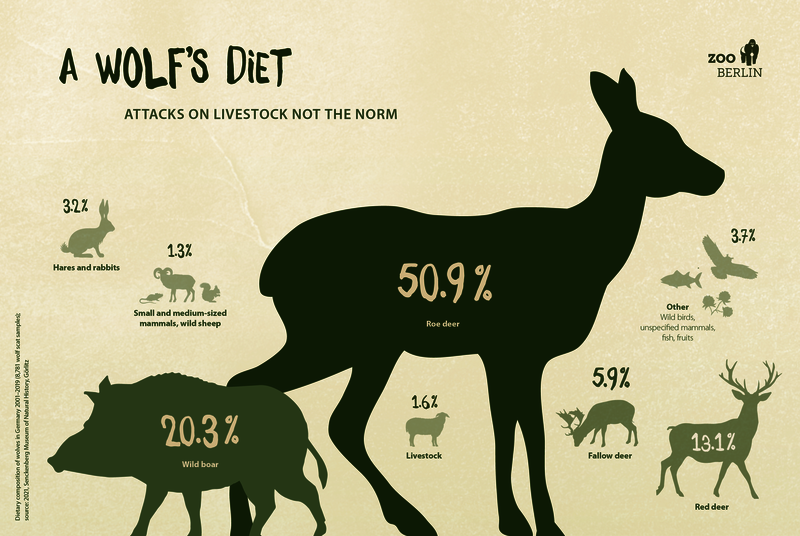
Research into what wolves in Germany eat has provided important perspective on the threat they pose to livestock. According to a study by the Senckenberg Museum of Natural History in Görlitz, which examined around 9,000 samples of wolf scat collected in Germany between 2001 and 2019, livestock accounts for only 1.6 percent of the canines’ diet.