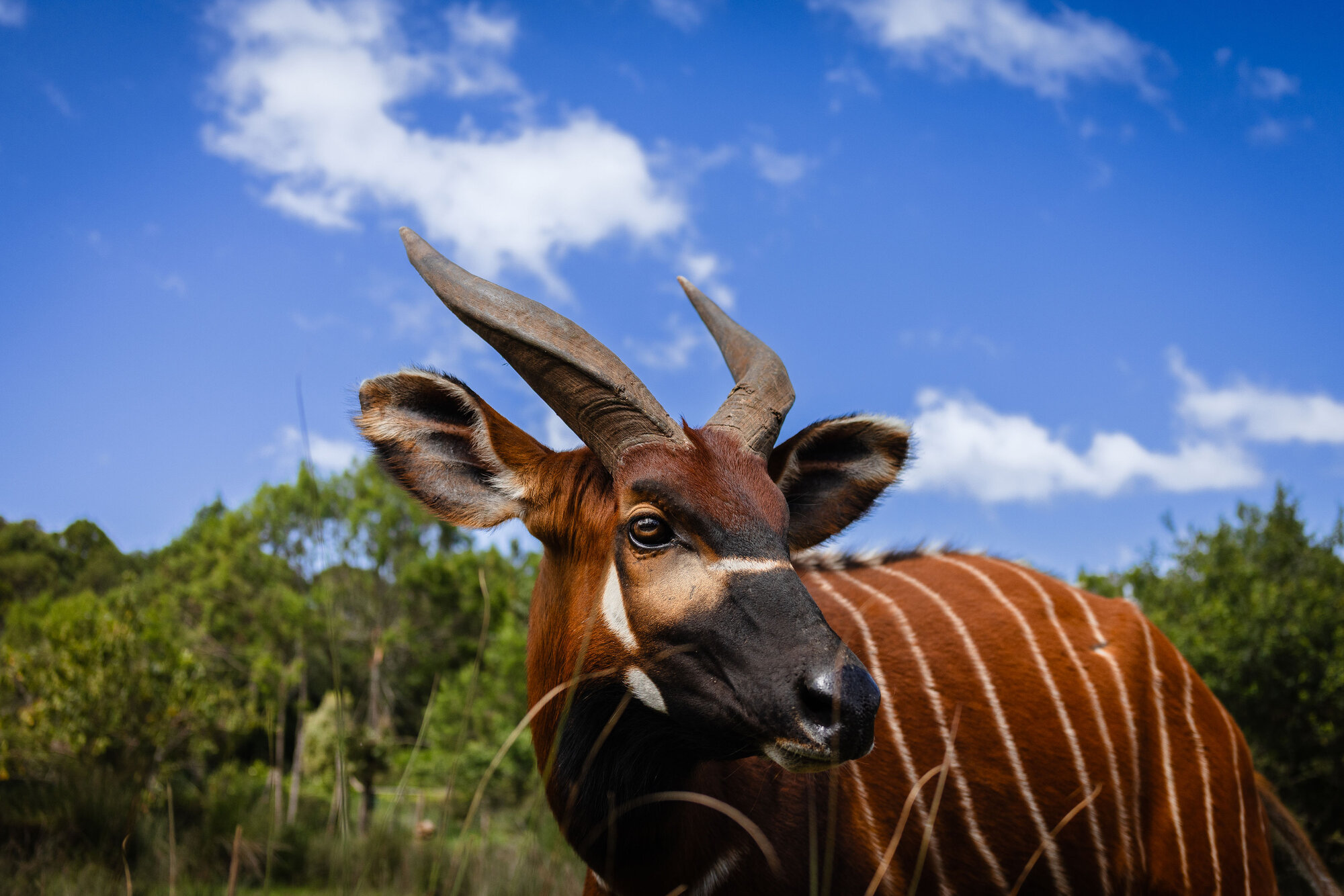
A mountain bongo from Zoo Berlin will become part of an international reintroduction project in Kenya – a significant step toward saving one of the rarest antelopes on Earth. Berlin Zoo is thus contributing to an international conservation initiative aimed at protecting the critically endangered mountain bongo. The world’s largest forest antelope is native to Kenya and occurs only in a few isolated forests in central Kenya. On the Red List, the bongo is classified as critically endangered; the most recent census by the Kenyan government estimates that only about 100 individuals remain in the wild, with populations highly fragmented.
These low numbers, along with the animals’ elusive nature, make it difficult to establish stable wild populations. Therefore, Kenya’s National Recovery and Action Plan for the mountain bongo identifies breeding under human care as one of the most important strategies for securing the species in the long term. The current initiative aims to return animals from European zoos, including Berlin Zoo, to Kenya in order to increase the genetic diversity of the wild population and establish new herds.
A total of four male animals are currently being transferred to Kenya as part of a scientifically supported program, one of which comes from Berlin Zoo. The male bongo, born in 2023, is expected to contribute to breeding efforts in Kenya and thus plays an important role in saving the species. “It is hard to imagine that only about 100 individuals of these impressive animals remain in the wild. As a modern zoological institution and long-standing keeper of bongos, we bear a special responsibility,” explains zoo and Tierpark director Dr. Andreas Knieriem. “We have great respect and admiration for the work of our colleagues in Kenya, who are dedicated to saving this species, and we are very pleased to be part of this important initiative.”
The reintroduction is being carried out in close cooperation with the European ex-situ program (EEP) of the European Association of Zoos and Aquaria (EAZA), which coordinates a genetically healthy and robust population of mountain bongos across 47 accredited European zoos. The goal is to strengthen the genetic diversity and reproductive viability of the population in Kenya and to establish stable herds for future reintroductions.
The selection of animals was carried out by the EEP coordinator and a species committee based on strict scientific criteria, including genetic representation, mean kinship values, age, and behavior.
Before departure, all animals undergo comprehensive veterinary examinations as well as a strictly regulated quarantine period. This takes place at Safari Park Dvůr Králové in the Czech Republic. After arriving in Nairobi, the animals are received by the Kenya Wildlife Service (KWS) and transported under veterinary supervision to the Mount Kenya Wildlife Conservancy (MKWC).
There, they are closely monitored and gradually acclimatized to their new environment before being integrated step by step into the existing breeding program. The aim is to enable healthy offspring for future reintroductions in Kenya.
Berlin Zoo received its first mountain bongos as early as 1971, and over many generations numerous offspring have been born. For more than 55 years, Berlin Zoo has been working to protect and preserve this impressive but endangered antelope species. “We feel very honored to be part of an extraordinary international network of different disciplines and cultures working together to return the mountain bongo to Kenya,” explains Christian Kern, Zoological Director of Zoo and Tierpark Berlin. “From our experience with other projects, such as our wisent reintroduction in the Caucasus, we know that such collaborative efforts can achieve real success,” he adds.
Conservationists from the United Kingdom, Denmark, the Czech Republic, Slovakia, Germany, and, of course, Kenya are involved in the project, carrying out the work on site. Dr. Erustus Kanga, Director General of the Kenya Wildlife Service, explains: “This project demonstrates Kenya’s strong commitment to implementing internationally recognized best practices in conservation. Through close cooperation with the European ex-situ program (EEP) and other partners, the reintroduction is supported by strict biosecurity measures, scientifically based population management, and long-term habitat restoration and protection. This integrated approach strengthens national efforts to rebuild viable and self-sustaining populations of the mountain bongo. As a species endemic to Kenya with high conservation significance, its successful recovery remains a top priority.”
“The bongo bulls from Europe are a central component of our reintroduction program. After reaching the milestone of 100 mountain bongos at the Mount Kenya Wildlife Conservancy, our focus is now on sustainable growth, with the long-term goal of building a population of at least 750 animals by 2050. The introduction of these genetically valuable animals will strengthen our breeding structure, accelerate population growth, and create a resilient population that enables long-term reintroductions into Kenya’s forests,” explains Dr. Robert Aruho, head of the Mount Kenya Wildlife Conservancy.
Background
The mountain bongo is one of the most endangered mammals on Earth and is a subspecies of the bongo, the largest forest antelope in the world. It is found exclusively in Kenya’s mountain forests and differs from the more common lowland bongo by its darker coloration and larger body size.
Since the 1950s, populations have declined dramatically. The main causes are poaching, habitat loss due to deforestation and agricultural expansion, and diseases—particularly rinderpest, which wiped out large parts of the population in the 1980s. Today, the remaining animals are confined to a few isolated forest areas, severely limiting genetic exchange and further endangering the species.
For several decades, zoological institutions have played a central role in protecting the mountain bongo. Through coordinated breeding programs, a stable reserve population has been established under human care. This now serves as a crucial foundation for international reintroduction projects such as the current program in Kenya. The long-term goal is to reestablish self-sustaining, genetically diverse wild populations and to secure the mountain bongo permanently in its natural habitat.
Picture: © Mount Kenya Wildlife Conservancy